

In the social media sphere, Twitch is one of the most popular live streaming platforms. It’s especially popular with gamers, who use it to share their gaming sessions with others online. But just how big is Twitch, and what are its demographics?
In this post, we’ll take a look at some of the most recent Twitch statistics. We’ll also explore some of the factors that have made Twitch so successful.
Twitch Key Statistics:
- There have been 1.28 TRILLION minutes watched on Twitch in the last year, higher than it was a year ago. That is a little more than 21 billion hours watched in the last year.
- There are an average of 5 million active streamers going live each month, down from 7.7 million Twitch channels streaming in 2020.
- For every live streamer, there is an average of 30.4 viewers, up from 28 in 2021.
- An average of 95,800 streamers are live on Twitch at any time.
- Twitch had 1.07 billion visits in April 2023, according to Statista.
- There are 52,000 Partnered Streamers.
- Gaules is the most watched Twitch streamer, with 10,131,732 hours watched last month.
- 17.93% of Twitch content is labeled as “mature.”
- Grand Theft Auto V is the most-watched game on Twitch.
- Just Chatting is the most watched category, with 238,480,189 hours watched last month.
Twitch Overview
Company Founded | June 2011 |
Headquarters | San Francisco, USA |
Founders | Justin Kan and Emmett Shear |
Industry | Live-streaming |
Parent Company | Amazon |
Twitch Demographics
Gender Ratio
According to Statista, 80.08% of Twitch users are male, and 19.98% are female as of July 2023. The gender of Twitch viewers has fluctuated a lot in the last few years, but is slowly trending back toward more male users than females.
In 2017, Twitch published its stats stating that 83.5% of the user base was male. The shift in userbase may have been influenced by the introduction of the Creative section in 2018, opening up many other categories for new streamers and viewers to enjoy.
While there are Twitch streamers in every genre, the platform tends to lean toward content that, stereotypically, males would gravitate through more. This may also be due to the toxicity toward women often found in many active channels across the platform.
Average Age
In 2022 the age demographics on Twitch is as follows:
- 18 to 24-year-olds: 35.85%
- 25 to 34 year-olds: 32.14%
- 35 to 44-year-olds: 15.33%
- 45 to 54-year-olds: 8.62%
- 55 to 64-year-olds: 4.97%
Younger people will make up the majority of Twitch viewership as they typically have more time to engage with Twitch streams. Those in the older generations typically lean toward content on YouTube or other websites where they can quickly consume content.
Top 5 Countries That Use Twitch
According to SimilarWeb, here are the top 5 countries that sent traffic to Twitch in December 2020:
- United States of America – 20.17% of users, down from 20.48% two years ago.
- Germany – 6.89%
- Russia – 5.35%
- France – 4.8%
- South Korea – 4.77%
- Others – 58%
Active Streamers
| Year | Active Channels |
|---|---|
| 2023 | 20 Million |
| 2022 | 9.9 Million |
| 2021 | 9 Million |
| 2020 | 6.9 Million |
| 2019 | 3.6 Million |
| 2018 | 3.3 Million |
| 2017 | 2 Million |
| 2016 | 1.8 Million |
| 2015 | 1.7 Million |
| 2014 | 1.5 Million |
| 2013 | 0.9 Million |
| 2012 | 0.3 Million |
How Many Twitch Partners are There?
In September 2022, there are 52,000 Twitch partners.
Active Viewers
| Year | Concurrent Viewers |
|---|---|
| 2023 | 2.4 Million |
| 2022 | 2.5 Million |
| 2021 | 2.84 Million |
| 2020 | 2.12 Million |
| 2019 | 1.26 Million |
| 2018 | 1 Million |
| 2017 | .074 Million |
| 2016 | 0.6 Million |
| 2015 | 0.53 Million |
| 2014 | 0.35 Million |
| 2013 | 0.2 Million |
| 2012 | 0.1 Million |
What is the Average Amount of Viewers Per Channel?
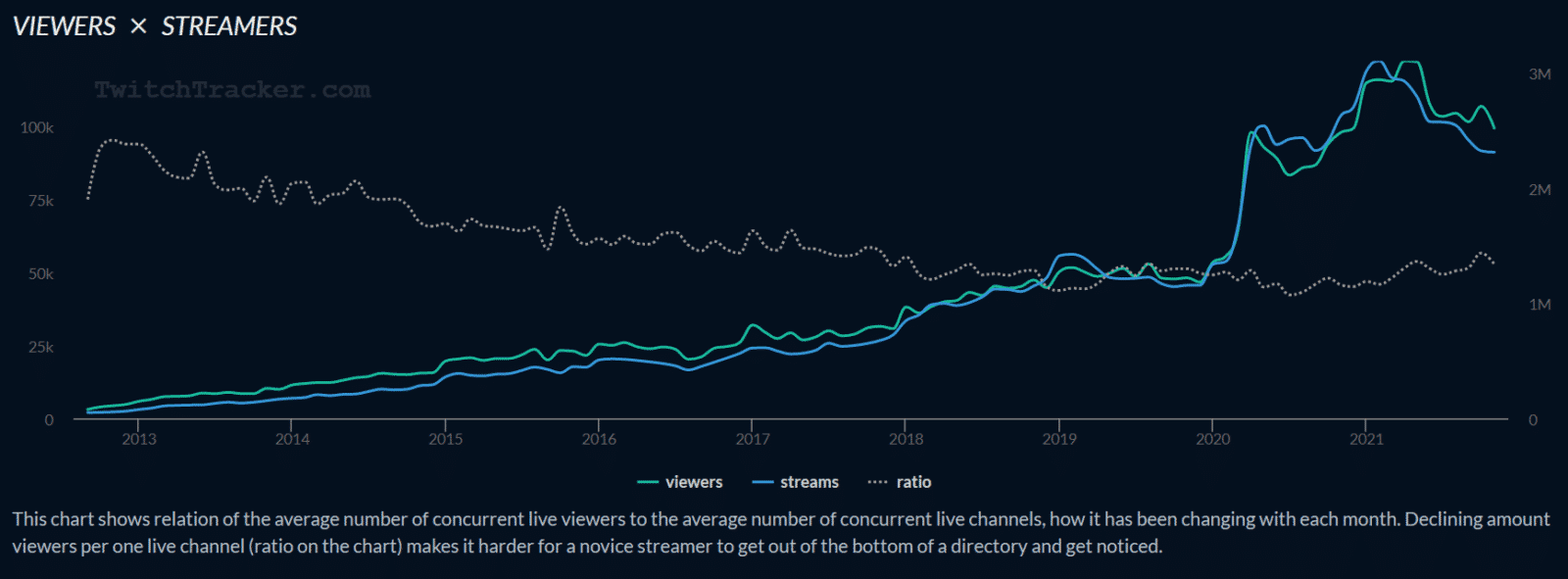
Even with the large increase of both concurrent viewers and streamers on Twitch over the past year, the average viewers per channel remained almost the same. At the time of this writing, the average number of viewers per channel is 26. This may seem like a strange measurement when the most popular twitch channels often average tens of thousands of viewers while the large majority of streamers are under even the current 26 viewer average.
Keep in mind the larger than average viewer count is the larger the pool for smaller streamers to hopefully get eyes on them.
Is Twitch Growing?
Twitch continually grew year over year from its initial launch in 2011 until 2022, when growth dipped 4.5% from 2021 levels.
The spike in users from early 2020 through to early 2022 was likely due to the Covid-19 global event that kept people at home. As people went into lockdowns in many parts of the world, Twitch use skyrocketed.
There is an average of 2.65 million viewers watching Twitch at any one time. This figure is up from 1.26 million in 2019.
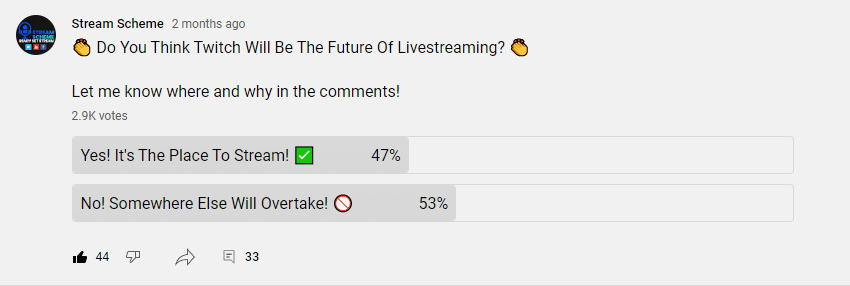
Despite the continued growth of Twitch, our recent poll of 2942 active streamers found only 47% believed Twitch was the future of live streaming.
Twitch Revenue
| Year | Total Revenue |
|---|---|
| 2022 | $2.8 Billion |
| 2021 | $2.6 Billion |
| 2020 | $2.3 Billion |
| 2019 | $1.5 Billion |
| 2018 | $0.9 Billion |
| 2017 | $0.4 Billion |
| 2016 | $0.1 Billion |
How Does Twitch Make Money?
Twitch earns revenue in the following ways:
- Ads – ads play at the beginning of a stream on every channel that is affiliated or partnered. While partners earn revenue from ads on their channels, affiliates split the revenue with Twitch.
- Subscriptions – Twitch earns 50% of the revenue from subscriptions made on every channel on its platform. In some cases with top partners, Twitch will take less of a cut.
- Bit Sales – Bits are Twitch’s platform currency. Viewers use bits to donate to streamers. Twitch takes a cut from Bit sales.
- Twitch Turbo – the Twitch Turbo subscription allows viewers to forgo seeing ads on the platform.
How Much is Twitch Worth?
According to Investopedia, Twitch is worth approximately $3.79 billion, nearly four times the amount that it was purchased in 2014.
Twitch Market Share
Twitch is the most watched live streaming platform. Here is how they measure up to their competition in the live-streaming industry:
- Twitch – 73% of the market share
- YouTube Gaming – 21% of the market share
- Facebook Gaming – 3% of market share
How Many Employees Work at Twitch?
According to Twitch’s LinkedIn, the company employs over 14,000 people worldwide. Twitch has offices all around the world; local teams are set up to work with Partnered streamers and specialize in the custom needs of each region.
How Has Twitch Influenced Other Industries?
Though Twitch was started to focus on video game streaming the site has evolved into much more than that. The “Just Chatting” section being the largest category has helped make the site inviting to those who would like to stream and build communities who don’t play video games.
How Has Twitch Affected the Gaming Community?
Twitch’s presence in the gaming community has been gigantic, to say the least. The site offers a way for users to instantly access and interact with communities for any game they want. Allowing users to find an audience that is interested in the same games that they are with great ease.
This can most easily be seen with the massive audience that is drawn to large gaming tournaments. The grand finals of Dota 2 and League of Legends tournaments reached hundreds of thousands of concurrent viewers.
Outside of these large tournaments which can thrive due to the large number of viewers they can attract; Twitch also gives smaller games and their communities a way to interact and organize content around the games they love. Allowing for the resurgence of older games or even games that previously had little to no audience until a streamer showed the game.
A great example of this is the “Among Us” craze that happened in 2020, a game that had been released two years earlier but became a hugely streamed game in 2020 when large streamers started live-streaming the game with friends.
Twitch Most Popular Games
The Twitch games with the most average concurrent viewers on the platform are as follows:
- Grand Theft Auto V – 160.4k average viewers
- League of Legends – 132k average viewers
- VALORANT – 118.7k average viewers
- Counter-Strike – 72k average viewers
- Dota 2 – 60.8k average viewers
The number of concurrent viewers will change throughout the live streams, but the above numbers reflect the average over a three-month period of time.
While watching people playing games typically takes most concurrent viewers, “Just Chatting” is the most popular category. A Twitch channel may choose this category when they merely want to speak to their following, either for the entirety of the stream or between games.
New streamers should note that even where there is a large amount of Twitch users viewing a specific game, there typically are a lot of Twitch streamers within the same category. Streaming in these games as a small streamer will make it nearly impossible to acquire Twitch viewers from within the platform.
Twitch Growth Infographic

Share this Infographic On Your Site
Please include attribution to Streamscheme.com
While Twitch stats will fluctuate from year to year, the most important metrics to pay attention to as a Twitch streamer are as follows:
- How many viewers do you have coming to your stream?
- Has the average number of concurrent viewers increased over time?
- What type of content do your viewers gravitate toward?
Keeping up with your personal monthly statistics will help you determine whether or not you are on the right path to success.